Every electronic device the Department of Defense buys has to work alongside other equipment without being disturbed by it, and without disturbing it. MIL-STD-461 is the standard that proves it. It defines how electromagnetic emissions and susceptibility are measured, what limits apply on which platforms, and how the results are documented. If you sell RF or electronic hardware into a defense program, you will meet it.
The standard was revised in April 2026. MIL-STD-461H replaced MIL-STD-461G, which had been in force since December 2015. This article explains what the standard covers, what changed in revision H, and what it means for RF module design.
What MIL-STD-461 Covers
Electromagnetic interference (EMI) travels two ways: conducted, along cables and power leads, and radiated, through free space. MIL-STD-461 tests both directions for both problems. Emissions testing measures what the equipment under test (EUT) puts out. Susceptibility testing measures how much the EUT can tolerate before its performance degrades.
That gives four families of tests, each identified by a two-letter prefix and a number:
- Conducted Emissions (CE): CE101 (low-frequency current on power leads), CE102 (radio-frequency voltage on power leads), CE106 (antenna terminal emissions).
- Conducted Susceptibility (CS): CS101 (power lead ripple), CS103, CS104 and CS105 (antenna port intermodulation, rejection and cross-modulation), CS109 (structure current), CS114 through CS118 (bulk cable injection, impulse excitation, damped sinusoid transients, lightning-induced transients, and electrostatic discharge).
- Radiated Emissions (RE): RE101 (magnetic field), RE102 (electric field, the test most RF products struggle with), RE103 (antenna spurious and harmonic outputs).
- Radiated Susceptibility (RS): RS101 (magnetic field), RS103 (electric field), RS105 (transient electromagnetic field).
Not every test applies to every product. The procuring activity tailors the set and the limits to the platform: an Army ground vehicle, a Navy surface ship, a submarine, an aircraft and a space vehicle each get different requirements. The contract’s EMI control plan says which apply.
What Changed in MIL-STD-461H
MIL-STD-461H was released on April 17, 2026, and applies to programs initiated after that date. It adds no new test methods and no new test equipment. The revision is about clarity and consistency, aimed at reducing disputes over interpretation between contractors, test labs and procuring activities. The changes that matter most for RF hardware:
- Finer emission scans. Step-tuned and synthesized receivers must now step in increments of one quarter of the measurement bandwidth or less, down from one half. That roughly doubles the number of measurement points in an RE102 scan, so narrow spurs are less likely to be missed.
- Analog-tuned receiver provisions removed. The bandwidth and measurement-time column for analog receivers is gone from Table II; modern labs use stepped or FFT-based receivers.
- Cable applicability clarified. CS114 through CS117 explicitly cover electrical cables, and CE101, CE102 and CS101 exclude power leads that do not connect directly to the platform power bus.
- CE101 for Navy platforms now extends to 20 kHz for surface ships and submarines (aircraft remain at 10 kHz).
- RS105 only where there is an EMP requirement. Transient field testing is no longer applied by default.
- Documentation is stricter. Test reports need photographs of the actual setups, ambient electromagnetic levels must be recorded, overload checks are documented for each measurement setup, and formal qualification testing requires procuring activity approval. RE102 antenna orientation is now defined precisely.
If your program started under 461G, its requirements still stand. New programs, and re-qualifications where the procuring activity asks for it, will be run to 461H.
Where the Testing Happens
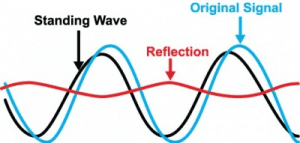
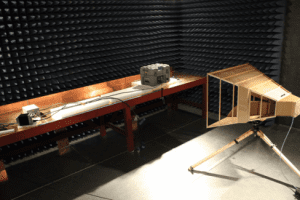
Radiated tests must be run in a controlled electromagnetic environment: a shielded enclosure lined with RF absorber. Pyramidal absorber handles the electric field; ferrite tiles handle the magnetic field. The result is a very low noise floor for the measurement receiver and no reflections, so the only energy the antenna sees comes from the equipment under test. The standard also sets dimensions and spacings for the setup so that results are repeatable between labs.
Conducted tests use line impedance stabilization networks (LISNs) on the power leads and current probes or injection clamps on cables. They do not need an anechoic chamber, but they do need a shielded room and a controlled ground plane.
Designing RF Hardware to Pass
Most MIL-STD-461 failures in RF modules come from a short list of causes, and all of them are cheaper to fix at the design stage than at the test lab:
- Harmonics and spurious outputs (RE102, RE103). A power amplifier produces harmonics at multiples of its operating frequency. A low-pass harmonic filter at the amplifier output, sized for the full output power, is the standard fix. NuWaves builds these as standard products; see the NuFilter 05LPLE-2500 miniature harmonic filter and the wider custom RF filter line.
- Power supply noise (CE102, CS101). Switching regulators are the usual source. Input filtering, layout and grounding decide the outcome; our post on keeping noise out of RF circuit power supplies covers the practical rules.
- Enclosure leakage (RE102, RS103). Seams, connector panels and ventilation openings radiate. Conductive gaskets, proper connector grounding and shielded cables close the gaps.
- Cable coupling (CS114, CS115, CS116). Interconnect cables act as antennas in both directions. Filtered connectors and common-mode chokes on the lines that leave the enclosure are the usual remedy.
How NuWaves Approaches MIL-STD-461
NuWaves designs its RF products and custom engineering work with MIL-STD-461 in view from the first schematic, so filtering, shielding and grounding are part of the architecture rather than a fix after the first test failure. We back that up with in-house testing: our anechoic chamber supports MIL-STD-461 confidence testing, along with MIL-STD-704 power-quality testing and selected MIL-STD-810 environmental methods. We can run many, though not all, of the methods in those standards, and we are not a certified test house. The purpose of our testing is to find and fix problems early, so that a design arrives at the certified test facility ready to pass formal qualification the first time.
That is part of what it means to offer a full spectrum of RF solutions from concept to production: designs that meet the specification on the first qualification run, on a schedule that fits the program.
Frequently Asked Questions
Is MIL-STD-461H mandatory for existing programs?
No. It applies to programs initiated after April 17, 2026. Existing programs remain under the revision called out in their contract unless the procuring activity directs otherwise.
What is the difference between MIL-STD-461 and MIL-STD-464?
MIL-STD-461 covers individual equipment and subsystems. MIL-STD-464 covers electromagnetic environmental effects at the platform and system level, where many MIL-STD-461-qualified units are integrated together.
Which MIL-STD-461 test do RF amplifiers fail most often?
RE102, radiated electric-field emissions, usually from harmonics or spurious outputs. A properly rated harmonic filter at the amplifier output is the most common corrective action.
Have a design that needs to meet MIL-STD-461H? Talk to a NuWaves engineer about filtering, shielding and pre-compliance testing before your qualification date.