Here’s what you need to know about heat sink design for the power amplifier.
Get the heat out of my PA!
Determining the proper heat sink for a PA requires consideration of how and where the PA is used. The duty cycle determines how much heat is generated over time: a 100% duty cycle use case will generate 35 W of heat continuously while a 25% duty cycle will average around 9 W of heat. The temperature of the environment the PA operates in determines the allowable temperature rise within the heat sink remains under the maximum PA baseplate temperature. Once these details are known, the heat sink selection may begin.
Why Thermal Design Matters in Power Amplifiers
NuWaves’ power amplifier (PA) products provide high performance in a small package. While the small footprint of the PA makes integration into a system easier, the thermal dissipation of the PA cannot be ignored. The typical amount of heat generated by a PA product is 50% to 65% of the total input power consumed. Learn more about our Power Amplifiers here.
Example: Heat Sink Sizing for the NuPower™ 12B01A
As an example, the NuPower™ 12B01A L- & S-Band Power Amplifier delivers 18 W of RF output from 53 W of DC input power. The difference between the DC input power and the RF output power is the amount of heat generated, which is 35 W in this case. To ensure reliable operation this heat must be managed such that the maximum operating baseplate temperature remains below 85°C. Thus, a heat sink with the capability to transfer this heat away from the PA is required.
Continuing with the 12B01A example, assume that the PA will be used at 100% duty cycle at ambient temperatures up to 60°C. The following equation is used to estimate the size of the heat sink required:
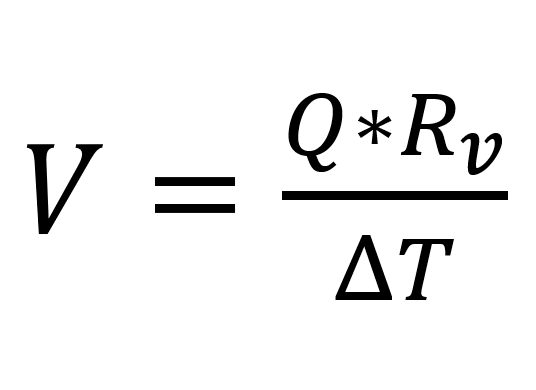
V = heat sink volume
Q = heat source power
Rv = volumetric thermal resistance
ΔT = the thermal budget (maximum baseplate temperature – maximum ambient temperature)
Approximate values for Rv are provided in the table below. For heat sinks with a volume of 100-200 cm3 the lower range of the Rv values should be used for a given flow condition. Large heat sinks with volumes up to 1,000 cm3 should use the higher range of Rv values. These values also assume that the heat sink incorporates fins that optimize for the given airflow.
| Flow Condition m/s (lfm) | Volumetric Thermal Resistance cm3 * °C/W (in3 * °C/W) |
| natural convection | 500-800 (30-50) |
| 1.0 (200) | 150-250 (10-15) |
| 2.5 (500) | 80-150 (5-10) |
| 5.0 (1000) | 50-80 (3-5) |
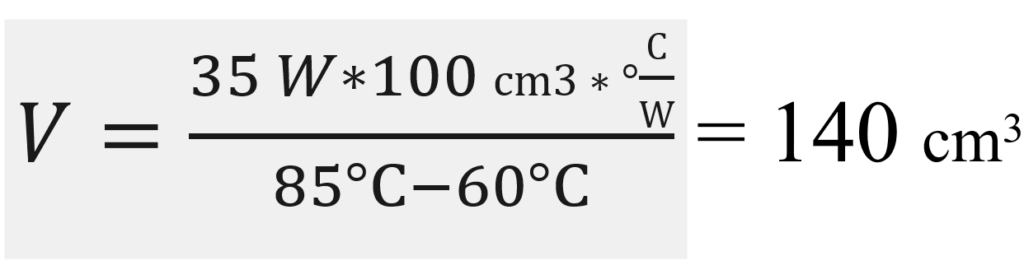
The example heat sink will incorporate a fan with an airflow of 2.5 m/s and will have a volume of less than 200 cm3, so the estimated Rv is 100 cm3 * °C/W. The maximum baseplate temperature of the 12B01A is 85°C. The heat sink volume required is then:
Key Factors That Determine Heat Sink Size
Ideally, the heat sink should be the same length and width dimensions of the 12B01A, which are 7.6 cm by 5 cm. From the calculated volume and the desired length and width of the heat sink, the height of the heat sink is calculated to be 3.68 cm.
Heat sink size (L x W x H) = 7.6 cm x 5.0 cm x 3.7 cm
Using this heat sink volume equation is a quick method to estimate the heat sink requirement for a given PA application.
For more details on these calculations, a good article titled “How to Select a Heat Sink” is available at https://www.electronics-cooling.com/1995/06/how-to-select-a-heat-sink/. A web-based heat sink calculator using this estimation method is available at https://celsiainc.com/calculators/heat-sink-size-calculator/.
Need help validating thermal performance for your Power Amplifier application? NuWaves engineers can help evaluate duty cycle, mounting conditions, and thermal margins early in your design. Contact us for assistance.
By Thoeun Huon - Director of Product Advancement & Technology Initiatives, NuWaves RF