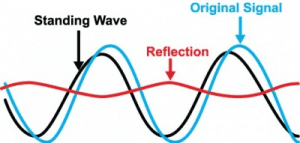
Is everyday RF exposure increasing our cancer risk? It’s a reasonable question—and one that comes up more often than you might think. We live in a world filled with radio frequency (RF) energy. Cell phones, Wi-Fi networks, radar systems, and countless wireless devices are constantly transmitting signals around us. With so much of this activity happening in the background, it’s natural to wonder whether it could pose a health risk.
Before jumping to conclusions, it helps to understand what RF energy actually is—and what it isn’t.
What is RF Energy?
RF energy is a type of electromagnetic radiation that includes radio waves and microwaves, commonly emitted from devices such as transmitting antennas.
Like all electromagnetic waves, RF signals are defined by key properties including wavelength (the distance required to complete one full cycle), frequency (how many cycles occur in one second), and power level (the amount of energy being transmitted). These factors together determine how RF signals behave, how they are used, and how they interact with materials, including the human body.
Frequency is measured in hertz (Hz), where 1 Hz represents one cycle per second. RF energy exists at the lower end of the electromagnetic spectrum, below infrared and visible light, with frequencies ranging from about 3 kilohertz (kHz) to 300 gigahertz (GHz).
Power level plays a critical role in RF exposure. In the engineering world power level is often expressed in dBm, a logarithmic unit that describes power relative to a milliwatt. When discussing exposure, however, power level is usually expressed in absolute units such as watts (W). Higher power levels result in greater energy absorption, which in turn leads to greater heating effects.
Most common sources of RF operate at relatively low power levels, which are well within safety guidelines. These sources include, but are not limited to, Wi-Fi routers, cell phones, Bluetooth, and radar. RF signals are widely used to transmit information wirelessly, enabling communication, navigation, and sensing technologies used in everyday life and advanced engineering systems.
Ionizing vs Non-Ionizing Radiation: What’s the Difference?
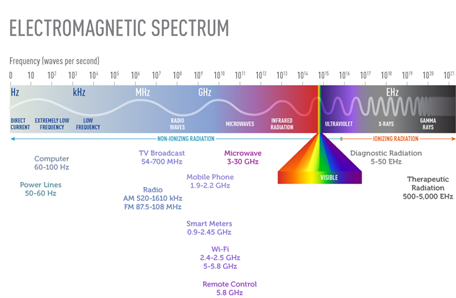
Image Courtesy of cancer.org
Electromagnetic radiation is often separated into two categories: ionizing and non-ionizing. The key difference between the two lies in how much energy they carry.
Ionizing radiation—such as X-rays, gamma rays, and some ultraviolet (UV) radiation—has enough energy to strip electrons from atoms in a process known as ionization. This process can break down chemical bonds or create highly reactive charged particles (ions) within cells. These ions can directly damage DNA strands or indirectly damage them by generating reactive molecules that interfere with the normal cellular structure. As a result, ionizing radiation is commonly associated with an increased risk of cancer.
Non-ionizing radiation, on the other hand, has significantly less energy and thus is incapable of removing electrons or directly damaging DNA strands. For this reason, its primary effect at high levels is producing heat.
RF energy falls into the non-ionizing category, along with visible light, infrared radiation, and lower-frequency electromagnetic waves. This distinction is important when considering how RF energy interacts with the human body.
How Does RF and RF Exposure Affect the Human Body?
At very high levels of exposure, RF energy can cause heating on body tissue. This is the same basic principle used in microwave ovens. Fortunately, these effects only occur at power levels significantly higher than the levels most people encounter in an everyday environment.
In typical daily life, exposure to RF energy from sources such as cell phones, Wi-Fi devices, and other wireless systems is relatively low. At these levels, the body is able to regulate any minor temperature changes without harmful effects.
This distinction becomes especially important when considering whether RF exposure is linked to cancer.
Does RF Radiation Cause Cancer?
Based on current scientific evidence and studies, there is no consistent or conclusive link between common RF radiation exposure and cancer. Large health organizations, including the World Health Organization (WHO) and the U.S. Food and Drug Administration (FDA), have reviewed the available research and have not found clear evidence that RF exposure at levels encountered in everyday environments causes cancer (American Cancer Society, n.d.).
Some studies have explored potential long-term effects of RF exposure, but results have been inconsistent, and no causal relationship has been established. A comprehensive review published in JAMA Oncology also concluded that there is no consistent evidence linking typical RF exposure to cancer (Grimes, 2021). These findings reflect the challenges of studying long-term, low-level exposures, where isolating RF effects from other environmental and lifestyle factors can be difficult.
Importantly, most everyday RF sources—such as cell phones and Wi-Fi devices—operate at power levels far below those known to produce measurable biological effects beyond minor heating. International safety guidelines are designed with large safety margins to ensure that public exposure remains well within established limits.
Overall, the current body of evidence suggests that typical exposure to RF energy from common sources does not pose a significant cancer risk, although research in this area remains ongoing.
How is RF Exposure Regulated?
Fortunately, RF exposure is not left unregulated. Various organizations and government entities have developed standards to ensure that radio frequency energy remains within safe limits.
In the United States, the Federal Communications Commission (FCC) sets exposure limits for RF energy according to recommendations from expert organizations such as the National Council on Radiation Protection and Measurements (NCRP). Many other countries use information from similar groups like the International Commission on Non-Ionizing Radiation Protection (ICNIRP).
These limits are designed with large safety margins and are set well below levels known to cause harmful biological effects, such as excessive tissue heating.
Devices like cell phones, Wi-Fi equipment, and other wireless technologies must comply with these standards before they can be sold or used, ensuring that everyday exposure remains within established safety thresholds.
Conclusion: Should You Be Worried About RF?
With RF energy all around us, it’s natural to have concerns about its potential health effects. However, current scientific understanding shows that RF energy, as a form of non-ionizing radiation, does not have the ability to directly damage DNA—the primary pathway by which radiation causes cancer.
While research continues, the evidence to date does not support a causal link between typical RF exposure and cancer. Combined with established safety standards and regulatory limits, this provides a strong basis for confidence in the safety of everyday RF exposure.
In short, while RF energy is everywhere, science indicates that it is not something most people need to worry about in their daily lives.
References
Grimes, D. R. (2021). Radiofrequency Radiation and Cancer: A Review. JAMA Oncology.
American Cancer Society. (n.d.). Radiofrequency Radiation. Retrieved from
https://www.cancer.org/cancer/risk-prevention/radiation-exposure/radiofrequency-radiation.html
By Ethan Chapel – Support Engineer, NuWaves RF Solutions